

Frankenburg missile house
Mission statement by Frankenburg Technologies CEO Kusti Salm
Our adversaries have industrialized missile warfare. Russia and Iran launch cheap drones and mass-manufactured missiles by the thousands, betting that the West cannot afford to intercept all of them. Frankenburg exists to prove them wrong.
Threat at industrial scale
Our adversary’s strategy rests on three assumptions:
- The West cannot manufacture at volume. Existing air-defence magazines are depleted faster than they can be replenished.
- No defence is airtight. Every strike that gets through creates disproportionate military, economic and psychological effects.
- Every exchange favours the attacker. Cheap drones and missiles force defenders to expend far more expensive interceptors.
The numbers back the bet. Russian production capacity has reached an estimated 300–400 Geran-type long-range attack drones per day. Its cruise and ballistic missile production has increased tenfold since 2022 and is on track to reach annual production of 10,000 units in the early 2030s. Other adversaries are not standing still. From Iran to China, they are developing more capable drones and missiles and are producing them at greater scale.
Legacy interceptors, produced in the dozens to hundreds per year, cannot keep up with this threat. Under saturation, even a small leak rate can create unacceptable damage, and every intercept trades a multi-million-euro interceptor for a threat costing a fraction of that. The question is no longer whether we can intercept. It is whether we can intercept at scale, and for how long.
Our answer
Frankenburg builds missiles designed to be fired in volume: low unit cost, high production rates, fast engagement cycles and simple logistics. We design our systems to meet the industrial nature of the threat, build cost-first supply chains that avoid single-vendor dependencies and use rapid test cycles to innovate and deploy capability faster. Our missiles are designed to launch from air, land and sea and to integrate seamlessly with both existing and future European air-defence architectures. Our partners provide sensors and battle management. We do what Frankenburg does best: manufacture air-defence missiles at industrial scale.
Why Missiles: The need for speed
Speed is a decisive advantage in air defence. Interceptor drones may offer persistence, but their relatively low speed limits how quickly they can respond, how far they can reach from a standing start, and how many opportunities they have to recover from an unsuccessful approach. Missiles accelerate rapidly to several times the speed of the threats they are designed to defeat, compressing the engagement timeline and enabling interception before an incoming drone reaches its target. This speed also creates the energy needed to engage crossing or receding targets, defeat fast manoeuvres, and prosecute multiple threats in quick succession. Against mass attacks, speed creates a larger defended footprint, reduces the number of threats leaking through and gives commanders greater tactical flexibility. It allows threats to be engaged earlier along their routes, rather than waiting for them to reach the defended asset.
This is why Frankenburg centres its approach on fast engagement cycles, scalable missile production and the ability to impose the engagement geometry.
Mark I: Cost-to-kill superiority and tactical mass today
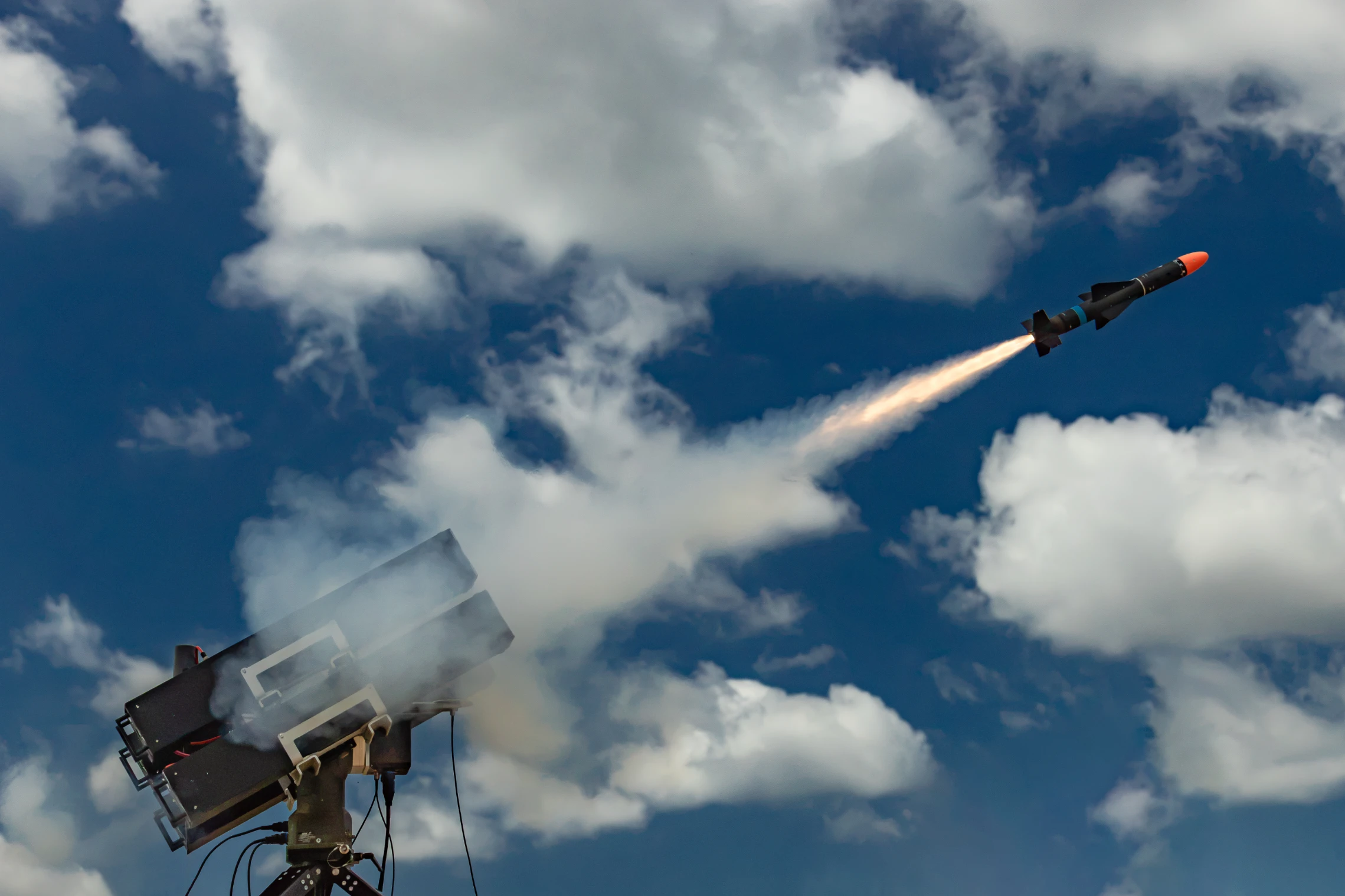
Mark I is a deployable VSHORAD counter-drone missile built for last line of defence that restores cost-to-kill superiority against mass-launched, low-cost aerial threats. We are now scaling its production. 100 missiles a day per factory, one missile every 4.5 minutes, on a path to one million missiles a year. With commercial pipeline of tens of thousands of missiles, Mark I is the engine that funds the next generation of interceptors.
Denying depth: Air-to-air and sea-to-air solution
Drone warfare’s biggest advantage is reach. We turn that advantage into weakness. Instead of meeting drones over the target, we use speed and mobility to take them down where we decide, earlier along the route, in cleaner engagement geometries and with lower collateral risk. With Airbus Defence and Space, Frankenburg has developed the Low-Cost Air Defence (LOAD) airborne platform solution, the technological backbone of the UK-led Low-Cost Air Defence Effector (LCADE) programme.
With Babcock and the UK, we are extending the same principles into the maritime domain, providing navies with a scalable maritime interceptor against mass drone attacks, allowing them to preserve their high-end missiles for high-end threats.
Mark II: Operational depth
Threats are flying faster and higher. Mark II extends the engagement range of Frankenburg’s interceptor to more than 10 kilometers, allowing it to reach combat and reconnaissance drones operating above the envelope of shorter-range systems at a speed beyond Mach 2. It also, and crucially, provides capability against traditional air defense threats, including cruise missiles, fixed-wing fighter and helicopter as well as Tactical Air-Surface and Anti-Radiation Missiles. Mark II also helps frontline units push back the ENY reconnaissance screen that enables strikes. It is designed to reliably target surveillance drones circling the line of contact and in the operational depth, denying the enemy the ability to observe, target and assess its attacks.
Mark X: Tactical Ballistic Missile (TBM) defence Europe can afford
Europe and its allies need an affordable and scalable answer to the TBM threat and cannot Patriot their way out of the TBM problem. Iran and Russia field large inventories of accurate, mobile TBMs that can be fired in mixed salvos built to exhaust defenders’ arsenals. Small numbers of high-cost interceptors cannot provide the magazine depth required to withstand sustained attacks.
Frankenburg’s Mark X, or Lower Tier Interceptor System (LTIS), is being designed for that reality: defending entire urban areas or critical infrastructure installations over roughly 2,800 km² per launcher position, engaging rockets and ballistic missiles with up to 2,000 km in range, firing 16 interceptors in 10 seconds, and enabling launcher reloads within 10 minutes. Mark X brings this to the hands of a warfighter with the same Frankenburg principles: 10x lower cost per kill and 100x higher manufacturing volume. Mark X accepts a lower single-shot kill probability in exchange for firing tempo, fast replenishment and vastly greater manufacturing scale. Modern missile warfare is won by magazine depth, not single-shot perfection.
Frankenburg’s TBM is not positioned as another “exquisite” interceptor. It is positioned as the missile everybody can afford to fire – enough times – to maintain an active defence under sustained attack.
The missile house the free world needs
When the fight becomes industrial, defence must be industrial too: magazine depth, tempo, and cost-to-kill ratios decide outcomes. Frankenburg’s systems are engineered for that purpose.
Across Mark I, Mark II and Mark X, Frankenburg is building a new model for air and missile defence based on affordable missile design, scalable production and a sustainable cost per intercept. We will apply the same principles to every new missile system we develop, from defence against mass drone attacks to cruise and ballistic missile defence, and adapt it as new threats emerge.
Kusti Salm
CEO of Frankenburg Technologies