

Missile systems
Our systems protect armed forces and critical infrastructure against large-scale aerial threats such as drone swarms and other low-cost airborne systems.
Frankenburg develops guided defence missile systems and the industrial capacity required to produce them at scale.
Frankenburg Mark I
Short-Range Air Defence Missile
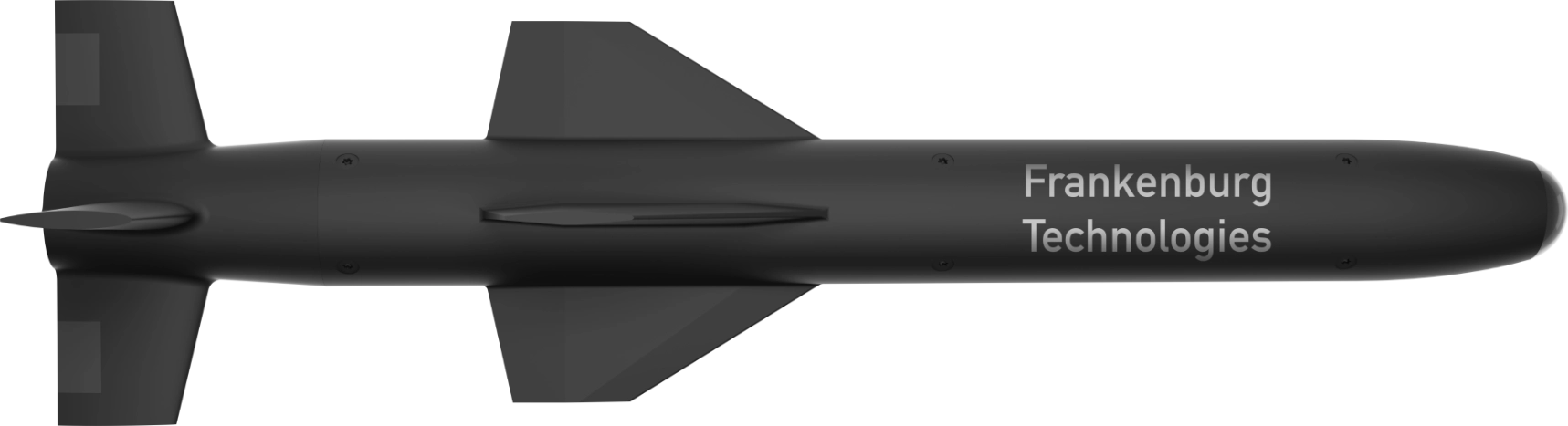
Mark I is Frankenburg’s first operational guided interceptor missile, designed to defeat Class I-III unmanned aerial systems (UAS), including drone swarms. Compact, affordable and mass-manufacturable, Mark I delivers scalable counter-UAS defence across land, air and maritime launch platforms.
In December 2025, Mark I successfully intercepted a moving Class III UAS target during a live-fire demonstration at the Ādaži NATO training area in Latvia.
Mark I is the smallest and lowest-cost guided interceptor missile ever live-fired, engineered for localised, sovereign mass production using commercially available components, and developed from concept to successful live-fire intercept in just 13 months.
Missile for every platform
Mark I is Frankenburg’s first operational guided interceptor missile, built for affordable counter-UAS defence across land, air and maritime launch platforms.
Targets
Class I–III UAS and similar aerial threats, including slow one-way attack drones with propellers (150–200 km/h) and faster targets using jet engines (450–600 km/h), including swarm-type systems.
Our missiles are platform-agnostic effectors, built to integrate with partner sensors, launch platforms and battle-management systems.
Performance
| Range | <2 km |
| Speed | High subsonic |
| Weight | <2 kg |
| Length | 0.65 m |
| Propulsion | Solid-fuel rocket motor |
| Engagement | Fire-and-forget |
| Warhead | Proximity-fuzed |
| Launch | Land, air and maritime adaptable |
Ground-launch applications
Mark I provides cost-effective point defence against UAS and drone swarms from Frankenburg’s compact ground launcher, with vehicle-mounted and robotic integrations to follow.
Military units and bases
Protect forces, command posts and base infrastructure.
Airports and ports
Defend transport nodes critical to military and civilian operations.
Energy infrastructure
Protect power, fuel and other critical energy assets.
Logistics hubs and industrial facilities
Defend sites essential to supply, repair and production.
Airborne-launch application
Mark I can be integrated on uncrewed aircraft to carry multiple missiles forward, with aircraft-dependent loadouts of up to 10 missiles, extending defensive reach beyond 100 km before missile launch.
Forward interception
Engage drones before they reach the defended area.
Drone route denial
Disrupt likely approach routes and transit corridors.
Counter-drone patrol
Patrol wider areas with onboard interceptor capability.
Airborne self-defence
Give uncrewed aircraft a dedicated counter-UAS effector.
Compact ground launcher
Mark I can be deployed from Frankenburg’s compact launch system, designed for rapid setup, simple operation and fast reload in field conditions.
Standard configuration carries up to four missile canisters.
Rapid deployment
Fast field setup.
Simple operation
Manual handling without specialised equipment.
Fast reload
Click-on and click-off single-use missile canisters.
Low logistics burden
Reduced transport, handling and storage requirements.
FieldFoundry
FieldFoundry is Frankenburg’s manufacturing model for rapidly-deployable, sovereign high-volume missile system production.
High-volume production
100 missiles per day per standard site.
Sovereign manufacturing
Local missile system production aligned with national defence needs.
Rapid relocation
Modular production capacity designed for quick setup and redeployment if conditions change.
Scalable output
Capacity expandable through additional lines and multiple sites.
Industrial resilience
Standardized workflows and shorter supply chains built to keep production running under pressure.
Built around modular production stations, lean manufacturing processes and standardised workflows, FieldFoundry has a standard site configuration of 100 missiles per day, with output scalable through additional production lines.
FieldFoundry helps partner nations establish local interceptor production capacity quickly, shorten supply chains and replenish stockpiles closer to the point of need.
Production can be deployed in existing facilities, temporary structures or containerised installations and scaled across multiple sites.
Frankenburg has established initial production capability in several NATO countries.
Future Systems
Mark I is the first missile system in Frankenburg’s broader air defence missile roadmap.
Future systems will apply the same principles: affordable missile design, scalable production and sustainable cost per intercept.